ISU unveils full $8.3M budget reduction plan: 'A foundation for another 125 years,' Wagner says
University details athletics funding shift, health sciences reorganization, revenue initiatives
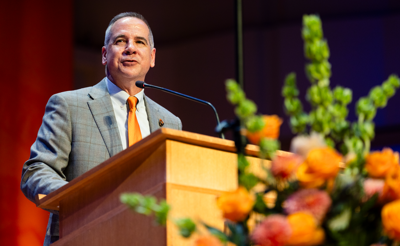
Idaho State University President Robert Wagner pictured during his inaugural address at the Stephens Performing Arts Center on Sept. 13, 2024.
POCATELLO — Idaho State University released its complete institutional budget plan Wednesday, detailing exactly how it will achieve $8.3 million in cuts to satisfy state mandates to implement a 3 percent reduction.
ISU President Robert Wagner and Provost Adam Bradford during a Wednesday afternoon interview with the Idaho State Journal provided an inside look at how the university worked collectively over the last several months to develop and communicate its comprehensive plan to the Bengal community, culminating in a Wednesday video where Wagner spelled out the impending changes.
“These budget reductions are not simply operational decisions or financial adjustments,” Wagner said in the video. “They affect people, colleagues and friends who care deeply about this institution and its students.”
The Budget Framework
The plan, first unveiled to affected academic units last week and then to the entire Faculty Senate during a presentation Monday, represents the university’s full response to state-mandated budget cuts — addressing not just previously reported academic restructuring but also athletics, health sciences, campus operations and revenue-generating initiatives.
Academic Restructuring
The merger creating the College of Humanities, Education and Social Sciences, or CHESS, will save approximately $1.8 million. The new college reduces administrative roles from six to three, eliminates two chair positions, implements a 50 percent chair compensation reduction and saves on adjunct costs through faculty retirements.
All arts programs will be unified under a new School of Arts led by an executive director rather than a dean, with hopes it will also generate revenue via performances.
“That school is designed to be an incredibly academic focused school for our students, but it can also be an entrepreneurial center because they engage, they do productions, they do shows and they do concerts,” Wagner said during the interview. “We want to encourage that. We want that to be successful.”
Bradford addressed accreditation concerns, especially for ISU education students, in a statement to the Journal this week.
“The Council on Educator Preparation, or CAEP, is the specialized accreditor for ISU’s education programs,” Bradford wrote. “The upcoming changes will not imperil our ability to continue to secure accreditation under CAEP’s guidelines. Our students will graduate from CAEP accredited programs, and our School of Education will still meet the accrediting guidelines necessary to retain their accreditation. The restructure will not change the accreditation of any of our current programs Universitywide.”
The Eli M. Oboler Library will save $326,364 through restructuring the dean’s position to an executive director, eliminating an associate professor position and an analyst position, and cutting two subscriptions including the Syndetics and Web of Science databases.
The Graduate School will eliminate five operational positions — two currently vacant — while consolidating functions with undergraduate services, achieving $260,000 in savings.
The Bengal Success Center consolidated two positions into an assistant director role. The Early College Program eliminated director positions, and the College Assistance Migrant Program and McNair Program positions were also eliminated, producing $342,207 in total reductions.
The College of Business will implement new summer course compensation rates, with adjunct faculty receiving about $5,000 for three-credit courses and full professors about $8,000. The college will eliminate three faculty positions. Combined with summer salary changes, the restructuring will save $521,797. The college is also incorporating sports management and human resource development programs previously housed in the College of Education.
The College of Technology is transitioning multiple programs from general appropriations to Career Technical Education funding, generating $841,560 in savings. Nursing and respiratory therapy programs are moving from Associate of Science to Associate of Applied Science degrees, allowing costs to be covered by CTE funds.
“Most of the impacts that we are feeling on the budgetary side is in our allocated funds,” Bradford told the Faculty Senate Monday. “That’s where these reductions are occurring, and so we have to find the savings in our allocated funds. We can’t use local funds.”
He continued, “For instance, the money we get from whatever, from running a football game to running clinic, we can’t use that to plug a hole in allocated funds.... Sometimes people talk about these as different colors of money and they have to be in the same buckets, so to speak. But we have some flexibility. We can look at moving programs ... and take costs that are currently being born out of the allocated budget and now incur those costs out of the CTE budget and the CTE dollars that we receive as an institution.”
ISU is also exploring whether to shift Emergency Services Department programs to the College of Technology, which could generate an additional $974,000 in savings if the university can tap into CTE funds.
The Kasiska Division of Health Sciences, or KDHS, will undergo substantial reorganization to balance administrative burden and create operational efficiencies.
ISU also intends to reorganize and rename The College of Health, which currently serves 3,418 students across 46 programs. The new College of Nursing and Rehabilitative Sciences will include the School of Nursing and the School of Rehabilitative Sciences, which includes communication sciences and disorders, counseling, physical therapy, athletic training, occupational therapy and the sport and exercise science program from the College of Education.
“We feel like this provides a more compact structure,” KDHS Vice President and Senior Vice Provost Dr. Rex Force told the Faculty Senate on Monday. “(It’s) still a very robust number of programs, faculty and staff that can support one another through shared services models.”
The College of Pharmacy will expand to become the L.S. Skaggs College of Pharmacy and Allied Health. The new School of Allied Health will incorporate community and public health, emergency services, nutrition and dietetics, radiographic sciences, dental hygiene, medical laboratory science and physician assistant programs, Force said.
Biochemistry, microbiology, and anatomy and physiology programs from the College of Science and Engineering will move to create a new Department of Biomedical Sciences within the College of Pharmacy and Allied Health.
This reorganization will result in approximately $400,000 in savings while addressing inequities in stipends and workload distribution. KDHS will standardize compensation practices that currently vary tenfold across departments.
KDHS identified strategic growth initiatives projected to generate between $521,958 and $705,613 in additional revenue by fiscal year 2029. Plans include increasing class sizes in audiology and the Doctor of Nurse Anesthesia Practice program, developing a new Bachelor of Science in Health Sciences with a pre-osteopathic medicine concentration in partnership with the Idaho College of Osteopathic Medicine, or ICOM, and expanding radiographic sciences to Idaho Falls — a campus Wagner told the Journal on Wednesday saw 4 percent enrollment growth this past semester.
Wagner said ISU’s Twin Falls campus also saw enrollment increases alongside success at the school’s Treasure Valley location where many of the KDHS programs are housed.
“The Meridian campus, focused on health sciences, is expected to continue growing,” Wagner said during Wednesday’s interview, noting the state’s critical need for allied health programs.
Athletics and Revenue Generation
For the first time, Wagner detailed significant changes to ISU’s athletics program, which will work to diversify its funding mechanisms.
“What’s happening with athletics is that we are lowering athletics dependence on institutional and operational funds, so they are going to turn more of their expenses and more of their future towards philanthropic and entrepreneurial and auxiliary sources,” Wagner said during the interview.
He spoke highly of ISU athletics’ role despite the challenging financial environment all collegiate athletics must navigate in an ever-evolving landscape.
“I’m a firm believer in the role of collegiate athletics,” Wagner said. “In many respects, our athletics programs are the front doorstep of this institution. We engage with our community and recruit for our student athletes — many of them would not have a higher education experience if it wasn’t for their athletic abilities and the opportunity to come.”
Wagner added, “We also need to make it financially sustainable. And athletics was not immune from these changes so they’re shifting more of their expenses off of central funds to other sources.”
Beyond cost cutting, the university detailed multiple revenue-generating strategies comprising nearly 20 percent of the $8.3 million target. KDHS will establish ISU Health, an entrepreneurial unit managing academic health clinics, Force told faculty.
With nearly 50,000 patient visits generating over $3 million in clinic revenue and more than 70,000 prescriptions filled at Bengal Pharmacy sites, the division sees growth potential, Force said.
A new director of clinical strategy and finance position, funded by ISU Foundation seed money, will be hired this July to optimize clinic growth with the goal of self-funding the position within three years, Force said.
Healthcare is a difficult business environment with low profit margins and a lot of regulatory compliance related things,” Force said. We need to have someone who can focus on that.”
The university will also implement market-aligned student fee increases in select areas, refine licensing and technology transfer processes to enhance revenue from ISU innovations and reconfigure the Idaho Accelerator Center to require service revenues to support operations.
Wagner announced in the video the creation of the ISU Innovation Hub with six focused centers designed to strengthen institutional capacity without new investment, including centers for change leadership, system improvement, strategic technology, faculty and staff training, product development and strategic planning.
Engagement Process and Leadership Response
The university’s plan to meet the state’s required cuts following a massive $450 million-plus tax relief package passed during the 2025 legislative session emerged from an extensive fall engagement process gathering over 2,000 ideas from faculty, staff and students, Wagner told the Journal Wednesday.
“We literally spent two and a half months in the fall listening and engaging and talking,” Wagner said. “I’ve had multiple people come up to me in the last two weeks to say it’s never been done this way at Idaho State before.”
When asked if he would change anything about the process, Wagner defended the approach, noting no process is perfect.
“It would be incredibly presumptuous and very prideful of me to just sit here and say we’re perfect,” Wagner said during the interview. “But I’ll tell you, I will stand by the things that we’ve done and more importantly, I will stand by the way that we did them.”
Bradford added during the interview, “We bet on our community. We said our biggest strength in this is going to be in pulling our people together and leaning into this together. I wouldn’t change that at all.”
Bradford also commended the work of the university’s Administrative Council.
“Every one of those vice presidents really leaned into this process,” Bradford said during the interview. “In many ways, it was not only deeply impactful, but frankly, it was transformative in our ability to navigate this. There were things as a vice president looking at the academic units from a certain perspective or vantage point that I don’t necessarily see in the unit’s specific operations. Things where we could make changes and see that those changes could be impactful, not only in terms of budget savings, but also better position us strategically to advance our mission as an institution.”
He added, “Those people that came to the table gave us that, and that’s the truth. The way they bought in and leaned into this process, truly, truly impacted me in ways I’m profoundly grateful for.”
Wagner spoke of the emotional toll, describing empathy and transparency as leadership priorities.
“These are difficult times. These are times when leaders first and foremost need to exhibit empathy,” he said during the interview.
When asked about potential “pity parties” considering the state met ISU’s recent enrollment success and budget balancing with demands for significant financial cuts, Wagner was direct.
“We don’t have time,” he said. ‘We are laying a foundation for another 125 years.”
Wagner confirmed ISU is preparing for potential additional cuts as the Idaho Legislature considers an extra 1 percent reduction for state agencies this fiscal year and another ongoing 2 percent in future years. Bradford told faculty during Monday’s meeting there’s no fat left to trim.
“There’s very little left to cut without some even more disruptive changes than the ones we’re currently involved in,” he said.
Despite challenges, Wagner expressed faith in ISU’s future, noting the school just achieved its first balanced budget in nearly a decade after eliminating a $15.5 million structural deficit. The 6 percent enrollment increase this fall marked four consecutive years of growth, alongside increases in research grants and philanthropy.
Implementation of the restructuring begins July 1. While remaining positive Wagner acknowledged there may be a need for additional initiatives such as early retirement incentives, scholarship redesign and program prioritization depending on the outcomes of this legislative session.
“I am the eternal optimist when it comes to Idaho State. If I were a betting man, I’d bet on Idaho State University,” Wagner told the Journal. “I believe strongly in Idaho State. Its roots run deep. Roots that are strengthened through adversity, through wind and rain and hail that buffet the tree. All that means is that those roots go deeper and they grow stronger because of that adversity. This institution has faced adversity in 125 years, and I believe it’s made us strong. It’s Idaho State University’s time. It is our time. It’s our time to shine.”